
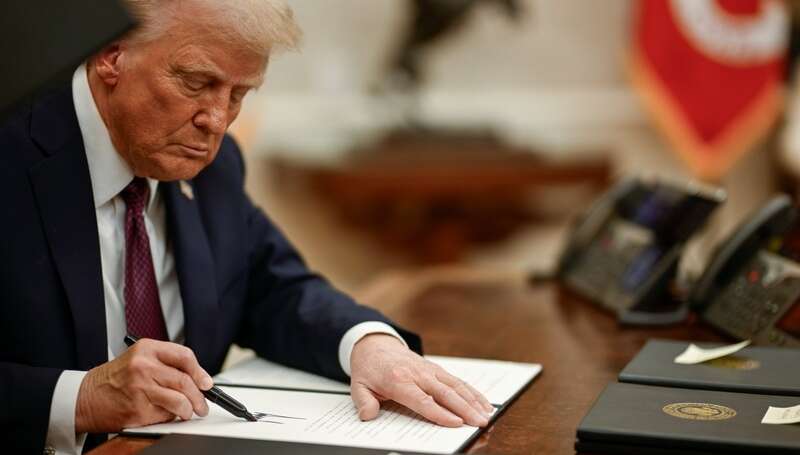
President Donald Trump signed an executive order Wednesday imposing new restrictions on major defense contractors, accusing parts of the defense industrial base of prioritizing shareholder returns over timely production for the military.
Trump said the order is intended to accelerate defense procurement and expand production capacity. It directs the federal government to curb stock buybacks and dividends for contractors found to be underperforming, while tightening oversight of executive compensation and contract compliance.
“While the United States produces the best military equipment in the world, we do not make enough of it quickly enough to meet the needs of our military and our partners,” the order reads, citing years of misplaced incentives that favored investor returns over readiness and on-time delivery.
“It is imperative that our defense contractors be held to the highest standards intended to ensure the advancement of core national interests, including with respect to the timeliness and quality of the defense items that they deliver,” the order says.
Under the order, contractors identified as underperforming would be barred from paying dividends or buying back stock until they meet standards for quality, timeliness, and budget discipline. Defense Secretary Hegseth is directed to review contractor performance within 30 days and, on an ongoing basis, notify companies of deficiencies and allow 15 days for remediation plans.
If remediation fails, the order authorizes enforcement actions permitted by law, including use of the Defense Production Act, which gives the president a broad set of authorities to influence domestic industry in the interest of national defense.
Future contracts would also prohibit buybacks and corporate distributions during periods of underperformance and require executive incentive pay to be tied to delivery schedules, production increases, and investment.
The order further calls for potential limits on executive base pay increases during periods of underperformance and asks the Securities and Exchange Commission to consider changes to stock buyback rules affecting defense contractors.
Trump doubled down on these points in a post on Truth Social, warning contractors against what he described as excessive dividends, stock buybacks, and executive pay while production lags.
“All U.S. defense contractors and the defense industry as a whole, BEWARE,” the post read. “While we make the best military equipment in the world (no other country is even close!), defense contractors are currently issuing massive dividends to their shareholders and massive stock buybacks, at the expense and detriment of investing in plants and equipment. This situation will no longer be allowed or tolerated!”
He also said executives should not earn more than $5 million until companies build new and modern production plants.
Trump floats $1.5T defense budget
Trump also suggested Wednesday that his administration will seek $1.5 trillion in military spending for fiscal year (FY) 2027, which would be a record level and hundreds of billions of dollars above recent annual defense budgets.
In another Truth Social post, Trump said the proposed level would replace an earlier $1 trillion figure and cited global security concerns.
“After long and difficult negotiations with Senators, Congressmen, Secretaries, and other Political Representatives, I have determined that, for the Good of our Country, especially in these very troubled and dangerous times, our Military Budget for the year 2027 should not be $1 Trillion Dollars, but rather $1.5 Trillion Dollars. This will allow us to build the ‘Dream Military’ that we have long been entitled to and, more importantly, that will keep us SAFE and SECURE, regardless of foe,” the post read.
The administration has not formally submitted a Pentagon budget request for FY 2027.
The Pentagon’s FY 2026 budget proposal seeks about $848.3 billion in discretionary base funding, with total national defense spending reaching roughly $1.01 trillion when supplemental and mandatory funds are included.
Congress has not yet passed full-year defense appropriations for fiscal year 2026.