
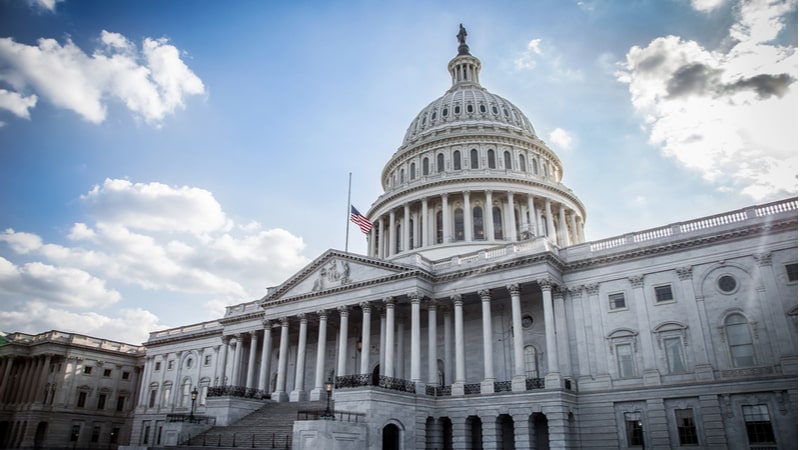
Congressional appropriators on Monday released a bipartisan, bicameral $180 billion funding package to finance key federal agencies for fiscal year (FY) 2026, taking a major step toward averting a partial government shutdown later this month.
The three-bill “minibus,” which would fund a wide range of agencies, is expected to advance through Congress in the coming weeks. The remaining agencies are still operating under a continuing resolution that expires on Jan. 30.
The deal largely rejects major spending cuts sought by the White House’s FY 2026 budget request, instead proposing modest reductions across a range of agencies and departing sharply from the Trump administration’s calls for sweeping budget cuts.
Modest cuts, major reversals
The spending package would trim funding for agencies, including the departments of Justice, Interior, Commerce, and Energy, as well as the Environmental Protection Agency, the National Science Foundation (NSF), and NASA.
Notably, NSF would see a nearly 4% reduction, rejecting the administration’s request to cut the agency’s budget by about 57%.
NASA would receive about $24.43 billion, a nearly 2% decrease from current spending. However, lawmakers rejected proposals to cut NASA’s science budget by nearly half and terminate 55 operating and planned missions.
The Energy Department’s Office of Science would see a $160 million increase, about a 2% boost, instead of the more than $1 billion reduction proposed by the administration.
Sen. Patty Murray, D-Wash., vice chair of the Senate Appropriations Committee, said passing the bills would reassert congressional authority over federal spending.
“Importantly, passing these bills will help ensure that Congress, not President Trump and Russ Vought, decides how taxpayer dollars are spent,” Murray said in a statement.
“This is a fiscally responsible package that restrains spending while providing essential federal investments that will improve water infrastructure in our country, enhance our nation’s energy and national security, and spur scientific research necessary to maintain U.S. competitiveness,” Sen. Susan Collins, R-Maine, the committee’s chairwoman, said in a statement.
Lawmakers also rejected proposed cuts to the National Institute of Standards and Technology (NIST), instead boosting funding for research areas including artificial intelligence (AI).
The agreement provides $55 million for NIST’s AI research, including up to $10 million to expand its Center for AI Standards and Innovation, and directs the agency to evaluate U.S. and Chinese AI capabilities and foreign models.
The package would provide roughly $1.8 billion for NIST, including about $1.25 billion for research in areas such as quantum information science, cybersecurity, and carbon dioxide removal.
The package provides NASA with about $24.44 billion, $5.63 billion more than the Trump administration requested, rejecting a proposed 47% cut to NASA science and maintaining funding for Earth science, exploration, and science, technology, engineering, and mathematics (STEM) education. It includes $7.78 billion for Artemis lunar exploration, $935 million for aeronautics research, and $143 million for STEM engagement programs.
Limits on workforce changes
The legislation also seeks to curb the administration’s efforts of unilateral agency reorganizations that could further shrink the federal workforce.
Under the bill, agencies would be barred from reprogramming funds to create or eliminate programs, relocate offices or employees, or cut more than 5% of the employees or funding supporting a program without congressional approval. It also prohibits agencies from using “general savings,” including personnel reductions, to alter programs approved by Congress.
House Appropriations Committee Chairman Tom Cole, R-Okla., said the bipartisan deal “reflects steady progress toward completing FY26 funding responsibly.”
“It invests in priorities crucial to the American people: making our communities safer, supporting affordable and reliable energy, and responsibly managing vital resources,” Cole said in a statement.
“This legislation reasserts Congress’s power of the purse. Rather than another short-sighted stop-gap measure that affords the Trump Administration broader discretion, this full-year funding package restrains the White House through precise, legally binding spending requirements,” Ranking Member Rosa DeLauro, D-Conn., said in a statement. “There is still much more work to do before January 30, but this is an important first step. I look forward to casting my vote in favor of this package.”