
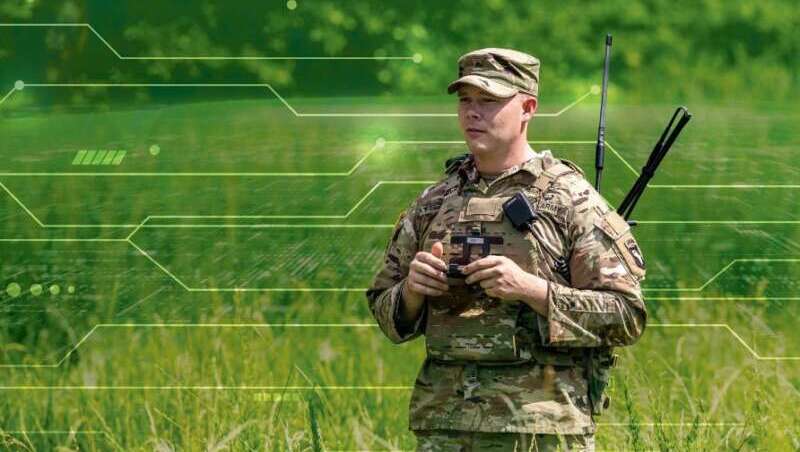
The U.S. Army is streamlining the acquisition of cutting-edge technologies, making it easier to deliver innovative solutions directly to soldiers through its Pathway for Innovation and Technology (PIT), officials said during a media briefing on Feb. 20.
The PIT aims to break down silos between the Army’s innovation units, accelerating the process of turning ideas into programs by coordinating efforts with the six program acquisition executives (PAEs) who manage funding and authority.
According to officials, the Army launched PIT as part of its acquisition overhaul, following reforms announced in November by Secretary of Defense Pete Hegseth.
“I sit at the table with the PAEs. I communicate directly with them to express what we are seeing. I also serve as a tech scout for them,” Col. Shermoan Daiyaan, director of PIT, told reporters. “This initiative brings together our innovation and rapid acquisition hubs at the headquarters level, giving us the muscle to push through what had previously been fragmented efforts.”
Within PIT, the Army’s FUZE program, Joint Innovation Outpost, and Global Tactical Edge Acquisition Directorate (G-TEAD) have established direct lines to acquisition offices, allowing more seamless collaboration.
“The way we used to do business is, before we even touch technology, we would spend a lot of time thinking about the idea of how we would use technology,” said Chris Manning, deputy assistant secretary of the Army for research and technology. “The shift here is: How do we get technology into operational formations much faster to see – are we even interested in this thing?”
The new pathway encourages collaboration across all stages, ensuring that both innovators and end users are involved early in the process to foster clearer communication on Army needs, officials said.
According to officials, PIT’s approach might involve competitions such as the xTech series, where companies develop solutions to specific Army challenges. Winning companies receive prize money and are then selected to field prototypes with soldiers for 30 to 45 days. If successful, these technologies could quickly scale through programs like FUZE’s Tech Maturation Initiative, where initial buys of equipment could expand from five units to as many as 100, alongside a five-year acquisition plan.
According to Daiyaan, the PIT efforts are still in the early stages of development. While he could not specify how many programs are in the works, he noted that there are hundreds.
Power generation and integration, particularly for unmanned aerial systems (UAS), is a key challenge that PIT is working on, Daiyaan said. For example, a universal charger would eliminate the problem of incompatible batteries across UAS vendors, he said.
The Army is also focused on partnering with nontraditional defense contractors and small tech startups to inject fresh innovation into the service. Col. Chris Hill, G-TEAD director, emphasized the importance of allowing industry to address challenges without imposing rigid solutions.
“One of the things that’s key to us is unleashing the power and ingenuity of industry,” Hill said. “In this space, we don’t tell industry necessarily how to do it. We just tell them the problem that we have right now.”