
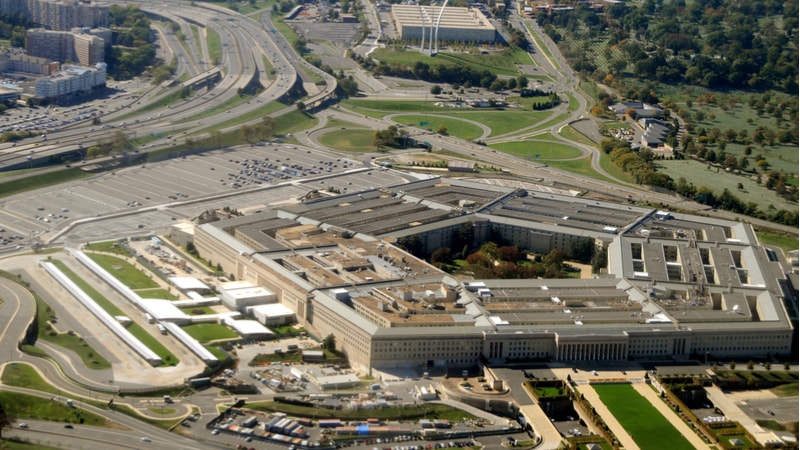
President Donald Trump has requested a record $1.5 trillion defense budget for fiscal year (FY) 2027, and a closer look shows how funding would be allocated across cyber, artificial intelligence (AI), missile defense, and drone efforts.
The budget marks a $445 billion, or 44%, increase over the previous year. Of the total, $1.15 trillion is designated for base discretionary budget authority and $350 billion would come from forthcoming reconciliation funds.
The Defense Department (DOD) – rebranded as the War Department by the Trump administration – is expected to release detailed budget justification documents in the coming weeks outlining program-level allocations.
Initial budget documents indicate the Department of the Navy would receive the largest share at $150 billion, including $126 billion in the base request and $24 billion in reconciliation funds. The Department of the Air Force, which includes both the Air Force and Space Force, would receive $101.2 billion, followed by the Army at $60.5 billion.
Funding for cyber-related efforts
The budget allocates $11.3 billion for cyber-related activities across the DOD.
U.S. Cyber Command is requesting about $2.1 billion in discretionary funding, including $303.7 million for operations and maintenance, $103 million for procurement, and $1.7 billion for research and development.
Additional cyber funding includes $1.2 billion for the Army, $680.7 million for the Navy, $371.1 million for the Marine Corps, $2.2 billion for the Air Force, and $290 million for the Space Force. Another $4.5 billion is designated for defense-wide cyber efforts.
Building the Golden Dome
The president’s Golden Dome missile defense system would receive $17.5 billion in FY 2027 funding. However, the program relies heavily on reconciliation funds, which account for $17.1 billion of the total, with slightly less than $400 million included in the base budget.
The funding would support operations and maintenance, procurement, and research, development, testing, and evaluation activities tied to the system.
Advancing AI
The administration is also seeking to expand military AI capabilities. The proposal includes funding for new AI technologies, infrastructure expansion, and continued development of the military’s GenAI.mil platform.
Notably, $4.2 billion is requested within the procurement budget for “sovereign AI infrastructure.”
Drone capabilities
Drone capabilities are another priority area. The budget includes $1.5 billion for unmanned aerial systems (UAS) efforts – including counter-UAS – across the department, as well as $2 billion for Army drone programs.
The Air Force is also initiating procurement of Collaborative Combat Aircraft, or drone wingmen, with nearly $1 billion in base funding. Earlier this year, the Air Force announced that the program recently entered a new phase of developmental testing, including weapons integration and system performance evaluations.
Space Force budget gets a major bump
The Space Force would see a significant increase, with a total budget of $71.2 billion, a 77% rise from the $40 billion enacted for FY 2026.
Much of the increase comes from research, development, test, and evaluation funding, which would total $38.4 billion in the base budget and $2.3 billion in reconciliation funds. Key programs include the Space-Based Moving Target Indicator initiative, which is slated to receive just over $1 billion.
Procurement funding would also grow, with $9.6 billion in the base budget and $9.4 billion in reconciliation funds. Major beneficiaries include the Space-Based Air Moving Target Indicator program and Proliferated Low Earth Orbit SATCOM.
Despite the overall increase, the proposal outlines reductions in certain research accounts for the Space Force. Basic research funding would drop by more than $3 billion, with about $2.6 billion of that reduction affecting the Space Force. Advanced technology development funding for the service would decline by $160 million.
Military members will be getting a pay bump, no civilian pay raise
The proposal includes pay raises for military personnel, continuing a trend from the previous year. Service members ranked E-5 and below would receive a 7% increase, those ranked E-6 to O-3 would see a 6% increase, and personnel ranked O-4 and above would receive a 5% raise.
The request makes no mention of a pay raise for the DOD’s civilian workforce, unlike last year’s proposal, which included a 1% increase.